
Toes Up
I learned one of my deepest life philosophies by falling out of a raft.
That sounds more dramatic than it felt when the day began. I was river rafting with friends, and before we got in the water, there was an orientation. A safety orientation, specifically. Important information. The kind you should probably listen to closely.
Unfortunately, we had already been day drinking.
Also unfortunately, I am very easily distracted by side conversations.
I do take safety seriously, so I was trying to tune in. I really was. But the river guides were talking, my friends were talking, my brain was doing whatever my brain does, and I absorbed just enough information to later believe it may have saved me.
The water was moving. The rapids were real. At first, it was fun in the way river rafting is supposed to be fun: wild enough to make you laugh, dangerous enough to make you feel alive, but still safely contained inside the idea that you are in a boat and the boat is where you will remain.
Until I didn’t.
At one point, the rapids came into the boat with such force that even though my feet were tucked in and my hands were where they were supposed to be, the water lifted me straight out. In a matter of milliseconds, the boat kept going, my friends kept going, and I was no longer in it.
That was the moment I understood: Oh. These are not pretend rapids.
Panic arrived immediately. Not as a thought, but as a whole-body alarm. The kind that does not ask permission. The kind that knows before you do that things have become very real.
And then, somehow, from somewhere in me, I heard the words:
Toes up.
I don’t mean I heard them with my ears. I heard them inside myself. Like a whisper from a part of me that had been paying attention when the rest of me was, admittedly, half-listening.
Toes up.
In fast-moving water, you are not supposed to put your feet down and try to stand. That instinct can destroy you. The current can catch your legs, push you into rocks, pin you, twist you, break you. The thing you want to do — the thing that feels most like control — can be the most dangerous choice available.
So I put my toes up.
My head was above the water. My toes were above the water. And I floated.
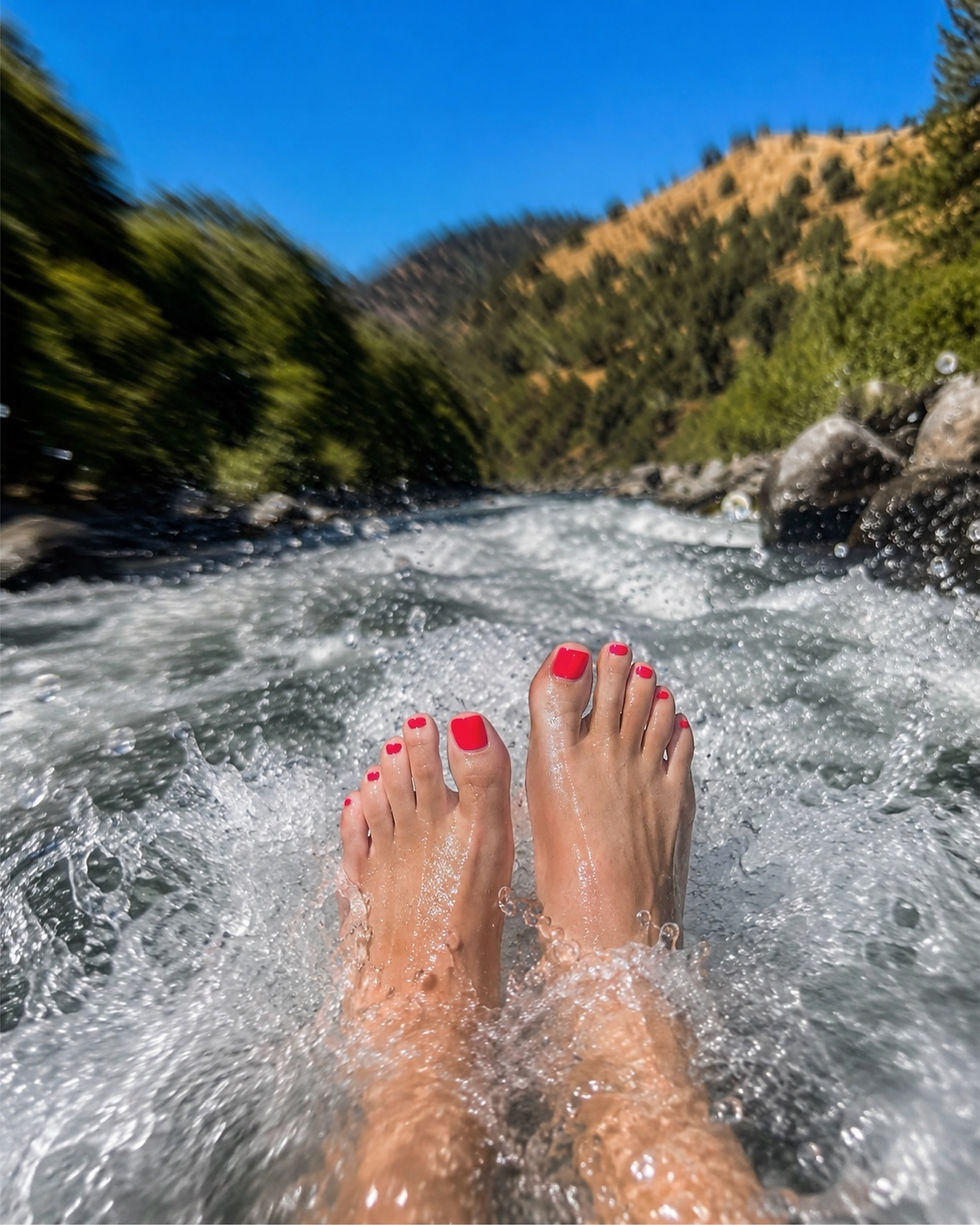
I floated through the part I could not control until the water calmed enough for me to be reached. My boat and my friends met me in the next still place. I came away without a scratch.
Without a scratch.
I have thought about that moment many times since, because it became more than a river story. It became a life lesson. Maybe even a spiritual instruction.
When the current is stronger than you, stop trying to stand in the rapids.
Toes up.
Years later, leukemia became another river.
That time, I did not choose the river. I was thrown into it.
On the same day I was diagnosed with cancer, I was told I had to move into isolation in the hospital for a minimum of thirty days. This was during COVID, so isolation meant isolation. No visitors. No casual comfort. No easy human touch. Doctors and nurses came in covered in protective layers. If I was touched, it was usually through plastic.
I would not say I felt lonely all the time, exactly. It was stranger than that. I was surrounded by care, but separated from the ordinary warmth of being human.
At one point, a nurse touched my arm with her bare skin, and I felt this wave of loving gratitude move through me. It was such a small gesture. It was just a hand on my arm. But in that moment, it felt enormous. Holy, even. I realized how much my body missed being touched like a person and not only treated like a patient.
The first phase of my cancer treatment was thirty days of being poked and prodded, tested and treated, scanned and studied around the clock. Every day there was another thing to get through. Another procedure. Another blood draw. Another unknown.
And somewhere inside all of that, I learned the same lesson the river had tried to teach me:
There is peace in trust.
Not because everything is safe.
Not because everything is easy.
Not because you understand every turn of the current.
But because once you are in the river, fighting the water does not necessarily give you more control. Sometimes it only gives you more bruises.
Trust does not mean abandoning discernment. It does not mean you stop asking questions, or stop advocating for yourself, or stop participating in the decisions that shape your life. I am not interested in a version of trust that asks anyone to disappear from their own experience.
The trust I am talking about is different.
It is the trust that lets peace come with you.
It is the trust that says: I have asked what I need to ask. I have chosen what I can choose. I am in the river now. I do not have to spend the whole ride kicking against the current.
Toes up.
Recently, I had to practice this again, but in a different way.
With leukemia, I was thrown into the river. With hernia surgery, I chose to step in.
That distinction mattered to me. I had time to think. Time to worry. Time to imagine every possible outcome. And I had a very real reason for fear: my uncle died earlier this year after a robotic-assisted abdominal surgery. So when I was preparing for my own robotic-assisted abdominal surgery, fear had plenty of material to work with.
I could have carried that fear all the way into the operating room. Part of me did.
But I kept coming back to what I knew. Not what I hoped. Not what sounded nice. What I knew.
There is peace in trust.
I could choose the surgery and still be afraid. I could acknowledge the risk and still receive the help. I could remember my uncle and still allow my own story to be my own story. I could step into the river and choose not to fight every wave before it even reached me.
That choice did not make the surgery nothing. It did not make recovery effortless. It did not erase six weeks of moving carefully, resting more than I wanted to, and living inside a temporary version of my life.
But it let peace come with me.
That is why I think trust keeps showing up in my music.
I am not writing about trust because it is pretty. I am writing about trust because I have evidence.
I have evidence from the river.
I have evidence from the hospital room.
I have evidence from the operating table.
I have evidence from grief, recovery, creativity, collaboration, and the daily practice of being a person in a world that does not always feel gentle.
Trust is not pretending there are no rocks.
Creative optimism is not ignoring reality.
It is choosing the perspective that lets you stay present inside reality without surrendering all your peace to fear.
That is what creative optimism means to me. It is not blind positivity. It is not denial. It is not painting a smiley face over pain. It is the decision to keep looking for the angle where love still has a way in. It is the practice of asking, “What can this become?” instead of only, “What has this taken?”
Sometimes optimism is not a mood. Sometimes it is a survival skill.
Sometimes trust is not a feeling. Sometimes it is a posture.
Head above water.
Toes up.
Let the current carry you to the calm place.


Comments